Research & development
Orbital Intelligence
Stay ahead of a changing orbit.
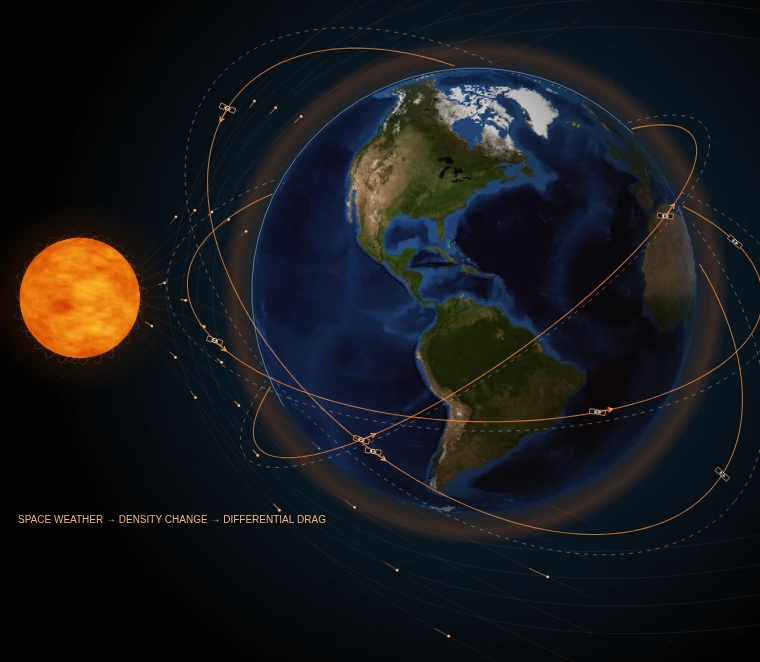
Connect space weather, upper-atmosphere change and satellite drag to the orbital picture—for one spacecraft or an entire constellation.
Review product scope
A connected space environment needs connected intelligence. HexaF is building Resilion—a physics-informed AI/ML platform for orbital awareness, navigation resilience, human-performance research and aurora prediction.
One scientific core. Four intelligence domains.
Platform in development · Product maturity varies.
Mission Support & Scientific Analysis
HexaF performs mission-related scientific analysis under a direct NASA purchase order.
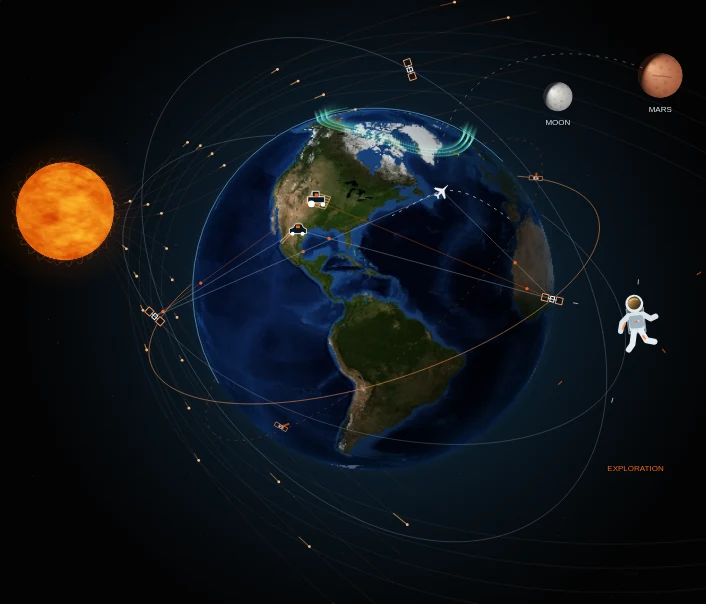
HexaF is building a comprehensive physics-informed AI/ML framework that connects the Sun, solar wind, magnetosphere, ionosphere, thermosphere and radiation environment.
The core combines observations, physical models and machine learning to develop useful intelligence—with provenance, uncertainty and limits visible.
Space Environment Intelligence
Observe → Understand → Predict → Protect → OperateResilion turns Space Environment Intelligence into focused products, with a shared path to dashboards, APIs, reports and decision support.
Connect space weather, upper-atmosphere change and satellite drag to the orbital picture—for one spacecraft or an entire constellation.
Review product scope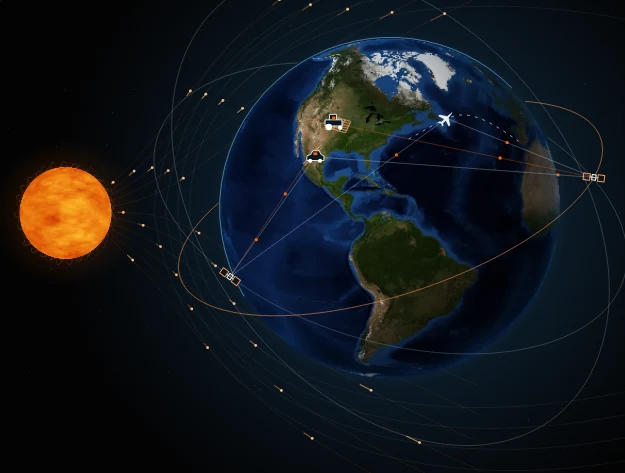
Understand how a disturbed ionosphere can affect GNSS/PNT performance across mobility, aviation and precision agriculture.
Review product scope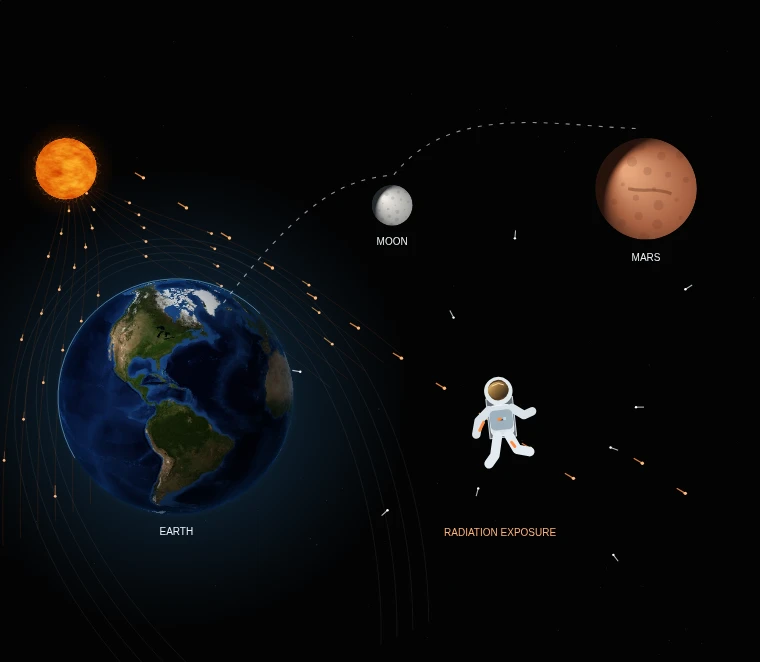
Connect radiation and environmental conditions to human-spaceflight research—from low Earth orbit to future Moon–Mars exploration.
Review product scope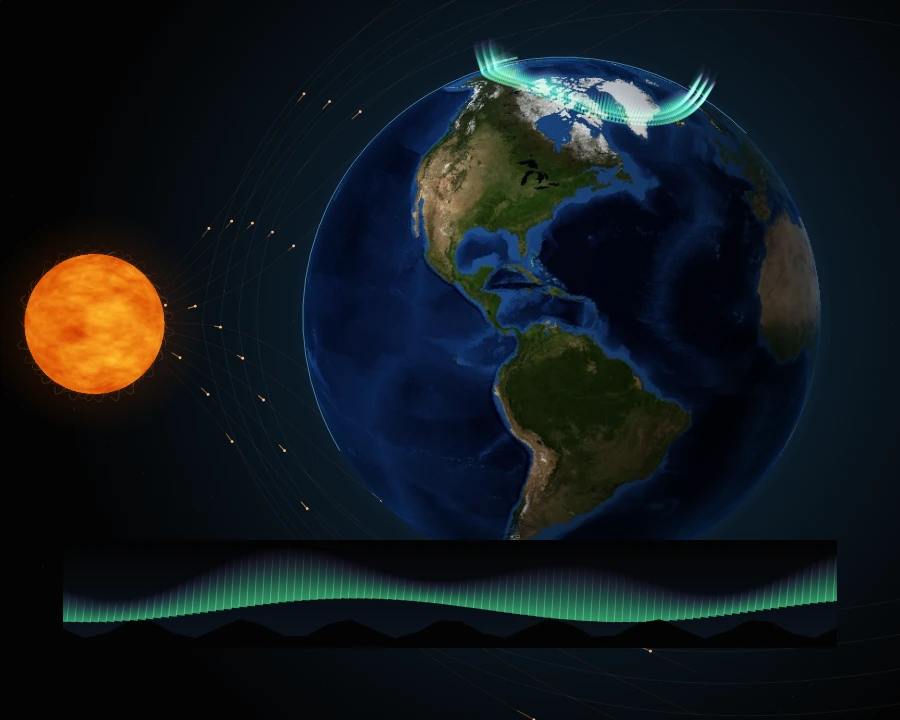
Bring the auroral environment into focus for chasers, photographers and researchers, with forecast context and uncertainty kept visible.
Review product scopeConceptual visualizations—not live telemetry, validated forecasts or operational guidance. Product scope and maturity are stated individually.
Space weather can affect the systems people rely on—power, communications, positioning, satellites and exploration. Resilion is being built to connect this changing environment to decisions in those markets.
These are potential applications and research pathways, not claims of deployed customer systems. The product roadmap stays focused on four intelligence domains.
Track geomagnetic disturbance that can drive currents through long conductors.
Potential application: combine environmental-event context with utility-owned exposure and engineering data.
Core research / integration opportunityDiscuss this applicationUnderstand disturbances affecting HF communications, GNSS and radiation context at high latitudes.
Potential application: environmental scenarios for aerospace resilience studies, not flight dispatch or route authority.
Navigation IntelligenceDiscuss this applicationConnect thermospheric change with drag variability and spacecraft environmental exposure.
Potential application: constellation-aware orbit assessment, event analysis and planning context.
Orbital IntelligenceDiscuss this applicationInvestigate guidance degradation alongside ionospheric conditions and receiver observations.
Potential application: storm-event context for equipment teams and field-navigation resilience.
Navigation IntelligenceDiscuss this applicationConnect environmental variability with positioning performance for connected and autonomous systems.
Potential application: receiver-data analysis and navigation-risk integration.
Navigation IntelligenceDiscuss this applicationConnect radiation conditions with astronaut and mission-performance research.
Potential application: research support for low Earth orbit and future Moon–Mars environments.
Human Performance IntelligenceDiscuss this applicationExamine geomagnetic conditions alongside long-conductor and infrastructure-system behavior.
Potential application: environmental baselines and event context for specialist engineering studies.
Core research / integration opportunityDiscuss this applicationAccount for external magnetic variability when interpreting sensitive geophysical measurements.
Potential application: survey-event screening and environmental context for magnetic data.
Core research / integration opportunityDiscuss this applicationConnect space-weather events with asset exposures and documented technical impacts.
Potential application: event reconstruction and exposure research; not insurance pricing or automated claims decisions.
Cross-product research opportunityDiscuss this applicationRead the changing auroral environment alongside darkness and local sky conditions.
Available pathway: AuroraAhead AI beta and source-based forecast guidance.
Aurora Prediction IntelligenceDiscuss this applicationUnify observations, physics-informed AI/ML and reproducible scientific analysis.
Engagement: mission-support analysis, data/model workshare and collaborative research.
Core science & mission supportDiscuss this applicationIndustry context: ESA commercial applications · NOAA space-weather impacts · NASA space-weather science. Source background describes environmental mechanisms—not HexaF product validation.
The delivery layer makes the science useful. Operational resilience, interfaces and deployment support all four products—they are not disconnected product categories.
Capabilities move from research to operational use through defined validation, integration and accountable human review.
Risk scores, risk windows, Resilience Index concepts, degradation context and alerts.
Uncertainty estimates, source provenance, assumptions and limitations alongside the output.
Focused interfaces, scientific event reports and documented decision-support products.
Interfaces that connect models and environmental information with customer workflows.
Deployment where technically appropriate, with application-specific validation and integration.
We lead with the Resilion architecture, physics-informed AI/ML approach and relevant product roadmap.
Together, we identify the right product application, evidence requirements and integration path.
Move into an agreed pilot, research collaboration or scientific-software work package—with clear responsibilities.
Meet the team building Resilion. Explore the product direction, see where it fits, and choose the next step together.